
On Subtext and Visuals
Creating Layers

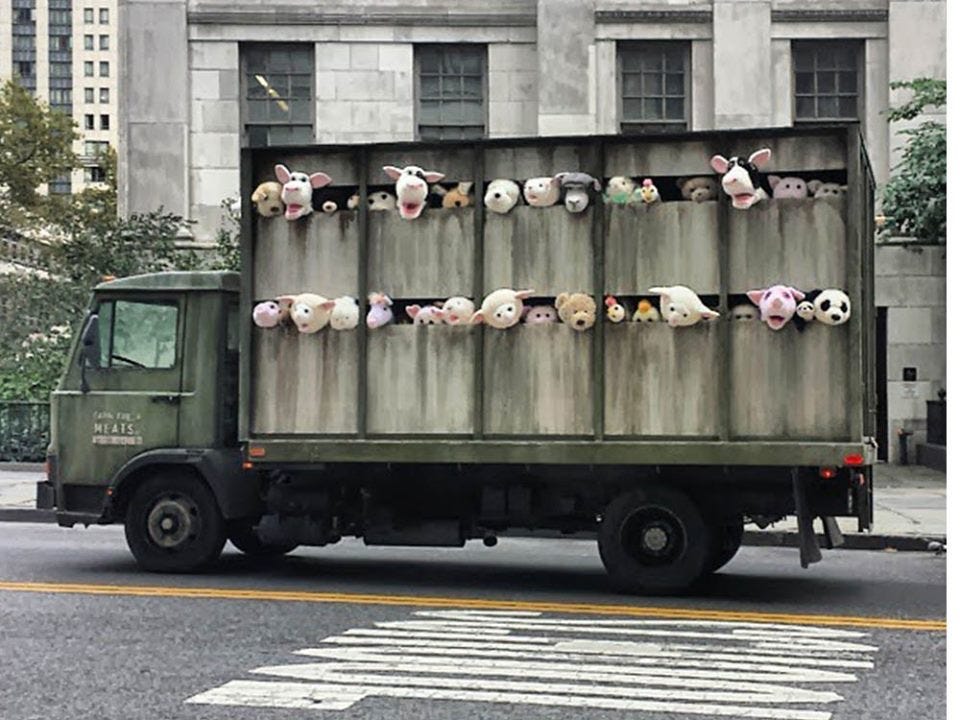
Do you hold a plushie and eat a cutlet? Exactly … None of us are innocent.
Sirens of the lambs, Banksie installation from October 2013.
The installation consisted of an old truck with stuffed animals depicting animals and the sounds they make. The truck drove around New York for two weeks, sparking variable, sometimes violent reactions around the world. In a simple gesture, he brings out all our hypocrisy and calls the perversion of our cruelty by its name. It is said that modern art arises in the artist’s dialogue with the viewer, it is a kind of game between these two sides. But what does it mean? Just take a look. Simply put, the artist notices the hypocrisy we all call the routine of everyday life and then finds a way to expose it. Banksie’s work is not played out in the street … Banksie’s work is played out in conscience. Do you hold a plushie and eat a cutlet? Exactly…
This is just one example of using visual art to heightened our conscience and emphasis a point we want to make by using extremes or subtleties. But either way attacking an issue from an unexpected angle before the viewer or the reader gets their fences up. That is the heart of subtext: letting the unstated truth be louder than the “message.”
Here is a short story I wrote while still running a motel
.
Language Is What Separates Us
My husband and I used to believe in words. It was an unproven, naïve conviction we clung to while running our motel—a firm belief that the right words carried the power to create harmony. Over the years, we drafted several forms for guests to sign, affirming that they fully understood the motel rules—the do’s and don’ts that, we hoped, would guarantee us peace of mind through clear and straightforward communication.
“Last call at 10:00 pm.”
“No smoking in the rooms.”
“No cancellations within 48 hours of the reservation date.”
“No pets.”
“Call us if you are going to be late.”
Every time one of our carefully crafted instructions was ignored, we were perplexed. We read and reread the words, convinced that somewhere in the correct phrasing rested our ultimate salvation.
Then we went to work—changing this word or that phrase, reading it quietly to ourselves and then aloud to each other.
Our happiness was always short-lived. Inevitably, some random guest would say, almost casually:
“Forty-eight-hour cancellation? Never saw it. You should be clearer next time.”
“The Wi-Fi password was posted in the room? Are you sure?”
“What’s this about no pets? Mine is more like the child I never had.”
“What! I can’t use my cousin’s twice-removed credit card? I’ll report that to the authorities.”
We rubbed our eyes, hoping to locate the fault in the words—those same words we had toiled over, changed and re-changed, to no avail.
And then one early morning, I watched a guest—who had checked in the night before—stand in front of a sign declaring in big bold letters:
“PLEASE DO NOT PRESS THE MICRO AND TOASTER AT THE SAME TIME, OR THE LIGHTS WILL GO OFF.”
And then, in slow motion, as if against his will, he did just that. The breakfast room went dark in an instant. He looked at me, bewildered.
“What just happened?”
I pointed at the sign, and at that moment—twelve years into our motel experience—I got it.
How could we be so blind?
Words—any words—are the real enemy. It is rarely about what was said or how it was phrased. The only words that matter are the ones each of us uses for internal communication with ourselves (herself too, to be politically correct—no specific race or gender intended). All the rest are nothing but white noise.
People sign without reading the documents we put together so carefully. The glazed look in our guests’ eyes when we try to explain this or that, the suspicious way our voice echoes over the telephone lines, hinting that no one is truly listening on the other end—all of these are clear indicators that words separate us from one another, not the other way around.